An RCMP road report can help you understand a police-reported collision, traffic disruption, or travel warning, but Alberta’s official highway condition service is 511 Alberta. For trip planning, use 511 alongside relevant Alberta RCMP updates rather than treating either as a complete picture on its own. This article explains where to check, how to interpret advisories, and how to distinguish travel information from collision records. (alberta.ca)
Where should you check an RCMP accident report in Alberta?
Start with 511 Alberta for highway conditions, closures, construction, and major incidents, then consult Alberta RCMP news releases for police-issued warnings about a specific event. The Government of Alberta operates 511 as a free traveller information service available by computer, mobile device, and telephone. Within Alberta, you can call 511 for highway information. (alberta.ca)
If you searched for “rcmp alberta road report” or “rcmp accident report alberta,” the useful distinction is between route conditions and police incident information. Alberta RCMP advisories address public-safety concerns surrounding particular events; 511 brings together transportation information needed to assess your route. In its own severe-weather advisories, Alberta RCMP directs travellers to 511 for up-to-date roadway information. (rcmp.ca)
Use these sources according to your immediate need:
- Planning a highway trip: Check 511 for surface conditions, closures, roadwork, and incidents.
- Following a police warning: Read the relevant Alberta RCMP release and any subsequent updates.
- Checking a wider emergency: Consult Alberta Emergency Alert alongside transportation information.
- Facing an emergency: Call 911; 511 is not an emergency assistance line. (alberta.ca)
This article explains the checking process, not today’s live road status. Before making a departure decision, open the official sources and review information for your actual route.
Read the location and timestamp before the headline
A useful RCMP highway report is specific enough to connect an incident with your journey. Look for the highway number, travel direction, nearby intersection or community, publication time, and any later update. For example, a Leduc RCMP collision notice identified Highway 2 northbound near Township Road 492—details that matter more for route planning than a broad headline about a highway closure. (rcmp.ca)
Make a habit of checking these details before changing plans:
- Match the location. Compare the named junction or road segment with your planned journey rather than relying only on the highway number.
- Check the direction. Identify whether the notice refers to northbound traffic, southbound traffic, or both.
- Read the full update. Look beyond the headline for restrictions, instructions, and whether the release supersedes an earlier notice.
- Compare with 511. Review the corresponding incident and closure information before departure.
- Keep uncertainty visible. If the information does not answer your question, do not fill the gap with an assumed reopening time.
Treat this as a reading checklist, not a substitute for official instructions. Its purpose is to help you avoid acting on a headline without understanding which part of your trip it concerns.
Checking Highway 2 without missing the affected stretch
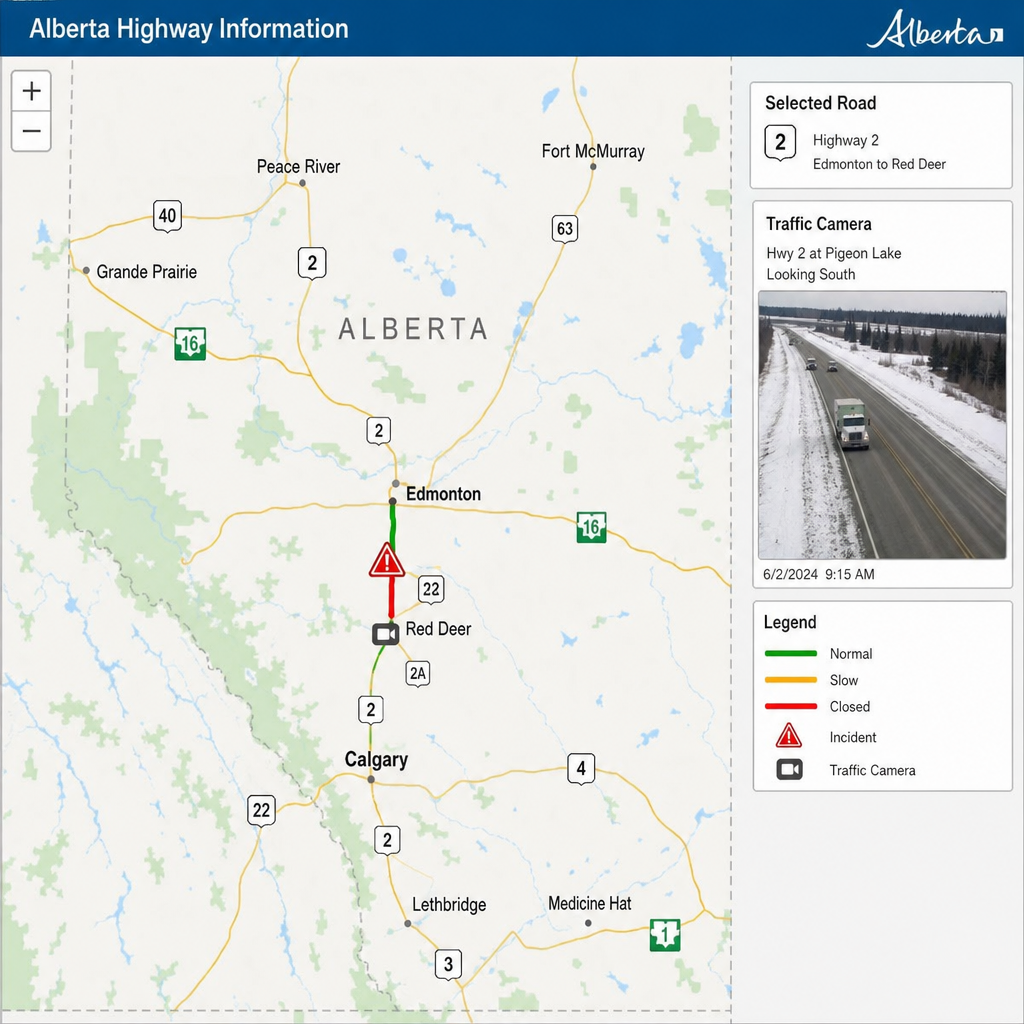
If you are looking for an “RCMP accident report highway 2,” check the particular section you intend to use rather than seeking one verdict for the entire highway. The 511 map lets you select road segments for detailed condition information and separately view closures, incidents, construction, and cameras. Use those layers together to investigate your route. (prod-ab.ibi511.com)
For a trip between Calgary and Edmonton, work through your planned journey in sections. Start near your departure point, move through the middle of the route, and finish with your destination approach. Then inspect the location named in any police advisory, rather than assuming that an incident elsewhere on Highway 2 affects you in the same way.
A practical checking sequence is:
- Open the road-condition layer and inspect the segments you will travel.
- Review incident and closure markers separately from surface conditions.
- Check construction notices for restrictions that could affect the same journey.
- Use available camera images as an additional view of selected locations.
- Read the matching RCMP notice if police have issued an advisory. (prod-ab.ibi511.com)
For example, imagine finding a northbound collision advisory while planning a southbound trip. Your next step should be to confirm the stated extent of the disruption, not automatically cancel the journey or assume it is unaffected. Use the notice’s wording and the corresponding 511 information to guide that decision.
Understand what road-condition labels mean
Searches for “rcmp road conditions” are best followed by checking Alberta’s official condition categories. On 511, partly covered indicates snow or ice on portions of the surface, while covered means the surface is completely covered with little to no bare pavement. Travel Not Recommended means conditions are unsuitable for non-essential travel; the road may be impassable because of surface conditions, extreme weather, or limited visibility. (511.alberta.ca)
These labels answer different questions from an incident notice. A condition category describes the road surface or travel environment, while incident and closure markers identify disruptions at specified locations. Read both before deciding what the report means for your trip. (511.alberta.ca)
In particular, do not interpret “No Report” as a positive statement that the road is clear. Treat it as a prompt to seek more information, not as reassurance. Likewise, do not substitute your own interpretation for an explicit warning against non-essential travel. (511.alberta.ca)
Take a travel advisory seriously
An RCMP travel advisory is a public-safety warning, not simply a prediction of a slower drive. Alberta RCMP says its travel advisories are based on real-time safety risks and are not issued lightly. Police may recommend against travel or temporarily restrict access, while highway maintenance and clearing are not RCMP responsibilities. (rcmp.ca)
When police advise postponing travel, consider whether the journey can wait rather than immediately searching for a way around the affected area. During severe weather, RCMP has warned that multiple collisions, stranded motorists, and poor conditions can lengthen emergency response times. Its guidance includes planning ahead, postponing travel until conditions improve, and carrying emergency supplies suited to the location and weather. (rcmp.ca)
Build your departure decision around three checks:
- Necessity: Identify what genuinely requires travel now and what can be rescheduled.
- Route: Confirm the official condition and restriction information for the intended journey.
- Readiness: Check emergency supplies, including blankets, food, and water, before leaving. (rcmp.ca)
Keep road information checking separate from driving. Review the map before departure, ask a passenger to handle further checks, or stop somewhere safe before using your phone. Alberta’s 511 guidance warns against accessing the site through a handheld device while driving. (511.alberta.ca)
Is an RCMP incident report the same as a collision record?
No. A public RCMP incident report or news release provides information about an event, while a collision record documents a reported collision for purposes such as an insurance claim. If you searched for “rcmp accident report” because you were involved in a crash, Alberta’s collision-report process—not the highway condition map—is the relevant starting point. (rcmp.ca)
Alberta says the driver copy of the collision report is all you need to start an insurance claim and can be obtained free through its Online Collision Report System. The police copy contains additional collision information, but it does not include witness statements, enforcement photographs, or information about whether charges were laid. (alberta.ca)
The online system requires the police file number. If you do not have it, contact the officer who responded or the agency where you reported the collision. A missing report may not yet have been completed, reviewed, and approved; follow up with the reporting agency rather than assuming no record exists. (ecollision.gov.ab.ca)
Keep obtaining an existing record separate from reporting a new collision. Alberta offers online reporting for certain eligible collisions in selected areas, but eligibility and availability must be checked through the official service. (alberta.ca)
Make the final check part of departure
Use a simple routine: check 511 for the route, read relevant RCMP advisories, and resolve any uncertainty before setting off. Alberta provides highway information online and by telephone, while emergency information is also available through Alberta Emergency Alert. (alberta.ca)
The goal is not to collect the most updates. It is to find the right information for the right road, understand what it says, and make a deliberate travel decision.